How to Photograph Reflections on Still Scottish Lochs
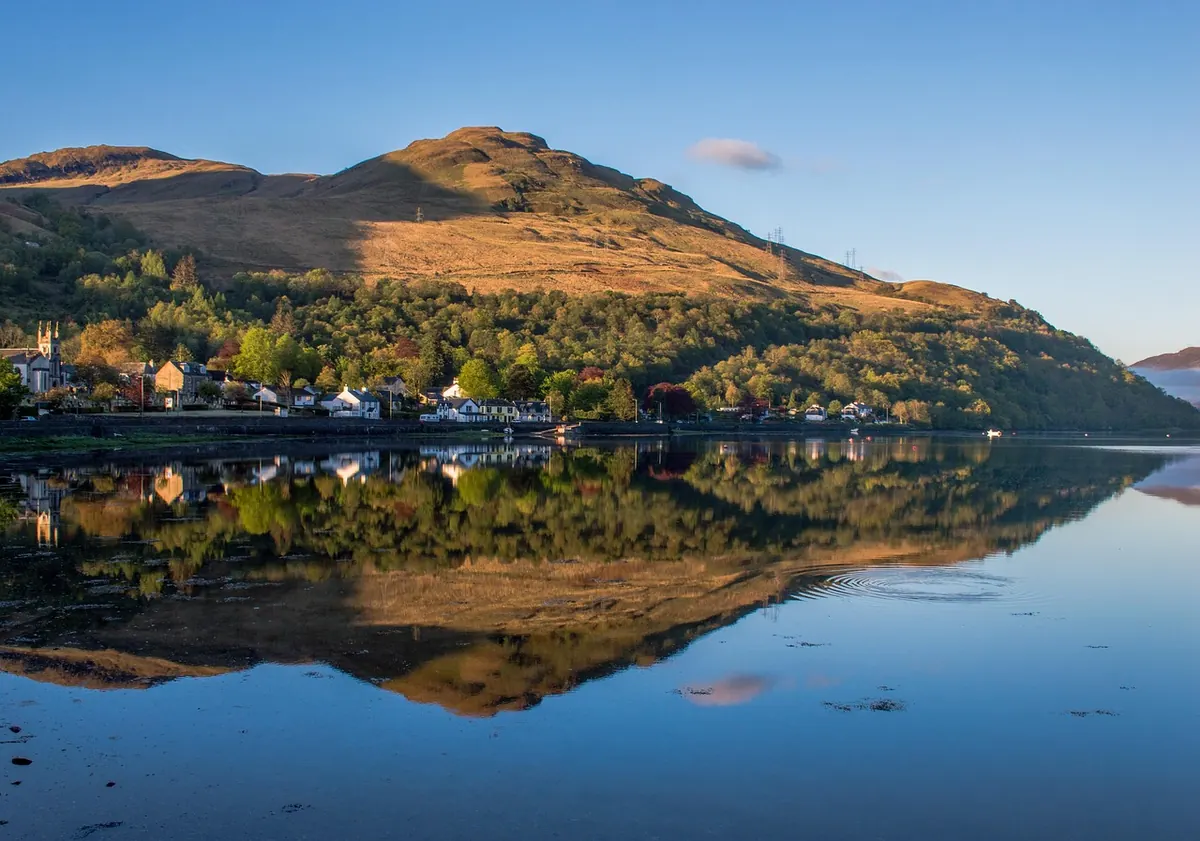
The water goes glassy for maybe twenty minutes before sunrise, and by eight it is a rumpled grey sheet with the wind coming down the glen. On Scottish lochs, reflections are a timing problem before they are a photographic one. Get the hour right, find ground that shelters the water, and the mirror does most of the work for you. Get it wrong and you will spend a week photographing texture instead of symmetry.
Start With the Wind Forecast, Not the Viewpoint
Before you decide where to go, look at the wind. It is the single factor that decides whether you come home with a mirror or a grey chop, and it does not need to be a gale to spoil things. Anything above roughly ten to twelve miles per hour across open water will break the surface into ripple.
What matters is fetch — the distance the wind travels over open water before it reaches the shore you are standing on. A bay behind a wooded point might have a fetch of a hundred metres and stay flat in a breeze that has the middle of a big loch looking like a gravel road. So check direction as well as speed, then work out which shore is in the lee. A westerly means the eastern side, and often the northern end of a loch too, where the ground rises against the weather.
Timing runs on the same logic. Calm usually arrives in the last hour of darkness and dies within an hour or so of the sun clearing the hills, when the ground warms and the air begins to move. Cold, clear mornings in late autumn and winter give the longest windows. Summer gives you a shorter one, an earlier alarm and a lot of midges — take repellent, and a head net if you plan to stand still.
Find the Sheltered Shore
Shelter is often within a few hundred metres of the car park. You just have to walk to it.
- Islands and promontories. Any land that interrupts the fetch flattens the water behind it. Wooded points, small islands and old boathouse jetties all create pockets of stillness.
- River mouths and deltas. Where a burn empties into a loch, the outflow often keeps a patch of water glassy, and gives you a natural foreground of stones and reeds.
- Narrows and steep-sided glens. Where hills close in on both sides, the wind has less room to build. Sheltered arms of larger lochs behave like small lochs in their own right.
- Small water beats big water. A hill lochan in a hollow above the glen is frequently still when the main loch is not. It is a shorter walk than you think, and there is usually nobody there.
Loch Ard and Loch Chon in the Trossachs are good low-risk examples: small enough, wooded enough, and ringed with bays that hold still on an otherwise breezy day. On a bigger sheet such as Loch Maree or Loch Assynt, the answer is almost always the lee shore behind an island.
Compose for the Mirror
Choose a subject with a clean silhouette
Reflections work when the mirrored subject is simple and reads as a shape: a single Scots pine, a boathouse, a ridge line, an island. Busy shorelines with fences, car parks and fifty shades of grey-green bracken turn into mud when they are mirrored. Walk until you find one strong shape rather than settling for the first view.
Decide which half of the frame wins
A dead-centre horizon only works when both halves are worth looking at. Often the reflection is the better picture — flat overcast skies are dull up top and beautiful below — so push the horizon high and let the water take two-thirds of the frame. In the reverse case, when the sky is doing something dramatic and the water is nearly black, let the reflection sit as a narrow band at the bottom.
Break the symmetry somewhere
Perfect symmetry can look like a printing error. A rock, a band of reeds, a drifting leaf or a single line of ripple gives the eye somewhere to start.
Rule of thumb: give the mirror an edge, not a lid. Keep foreground objects off dead centre and leave a sliver of clear water between them and the reflection of your main subject.
Expose for the Highlights
Bright sky reflected in dark water is a high-contrast scene, and the reflected clouds blow out fast.
- Meter the brightest water, not the mid-tone. Take a spot reading from the brightest ripple or the reflected cloud, place it near the top of the histogram, and let the hillside go dark. Shadow recovery in a dark shoreline turns grainy quickly.
- Use a polariser with restraint. It deepens skies and cuts glare on wet rock, but reflected light from water is itself polarised, so turning the filter too far can erase the mirror you came for. Set it, then back off a quarter turn and check the image on the back of the camera at 100%.
- Add a graduated filter when the sky is bright. A two-stop soft grad across the top of the frame tames the sky without putting a grey band over the reflection. If the light is changing, bracket three frames a stop apart instead and blend later.
- Keep ISO low and aperture mid. Around f/8 to f/11 is usually the sharpest and gives you depth front to back. Drop the tripod low — water-level shots make reflections feel longer and pull the viewer onto the surface.
- Let a long exposure help you. Two to ten seconds smooths small residual ripple into a clean surface. It can rescue a loch that is almost, but not quite, still.
When the Water Will Not Hold Still
Sometimes the wind simply wins. That is a signal to change the photograph rather than fight it. Shoot the ripple as texture — a fast shutter around 1/125 sec freezes the pattern of small waves into something graphic, especially with low side light raking across them. Look for partial reflections instead of whole ones: the top of a mountain reflected while its base dissolves into moving water can be stronger than a perfect mirror.
Wind also pauses. Squalls pass, and there are usually lulls of thirty seconds or more between gusts. Set your composition, wait, and fire in the gap. And if nothing settles, wait for the mist or the last light — flat water is not the only reward for an early start.
A Field Routine That Works
- Check wind speed and direction the night before, and pick a loch with a lee shore you can reach on foot.
- Arrive forty minutes before sunrise. The best water is often before the light is at its most dramatic.
- Walk the shore for ten minutes and identify one clean silhouette to reflect.
- Set the tripod low, level the horizon carefully, and find a foreground element at the frame edge.
- Fit the polariser, meter for the brightest water, check the histogram, and shoot the mirror first.
- When the wind arrives, switch to ripple, texture and detail rather than packing up.
Then put the camera down for a minute and look at the loch as it is. It will be gone by nine.
Photo: CameraMan095 / Pixabay